Big Walk Review Roundup — 96% Positive on Steam, 91 on Metacritic
Published 2026-09-215 min read
Is Big Walk good? The numbers say yes: 96% positive across 37,000+ Steam reviews and a 91 Metascore. What players and critics praise, who the game is for, and who should skip it.
Is Big Walk good? The aggregate numbers are unusually emphatic: since launching August 4, 2026, the game sits at 96% positive across more than 37,600 Steam reviews — "Overwhelmingly Positive", Steam's highest band — and holds a 91 Metascore from critics on Metacritic. Both figures checked September 21, 2026. For a $19.99 cooperative walking game from a four-person studio, that is not just good; it is one of 2026's best-reviewed releases.
The scoreboard
| Metric | Score | Checked |
|---|---|---|
| Steam review score | 96% positive (37,605 reviews, "Overwhelmingly Positive") | Sep 21, 2026 |
| Metacritic (critics) | 91/100 | Sep 21, 2026 |
| Metacritic (users) | Still accumulating | Sep 21, 2026 |
For context: House House's previous game, Untitled Goose Game, was a global phenomenon that made "horrible goose" a household phrase. Big Walk is their follow-up, published by Panic — and the review pattern echoes the studio's signature: simple verbs, meticulous craft, and comedy that emerges from systems rather than scripts.
What the praise is actually for
Read across the review body and the same themes recur:
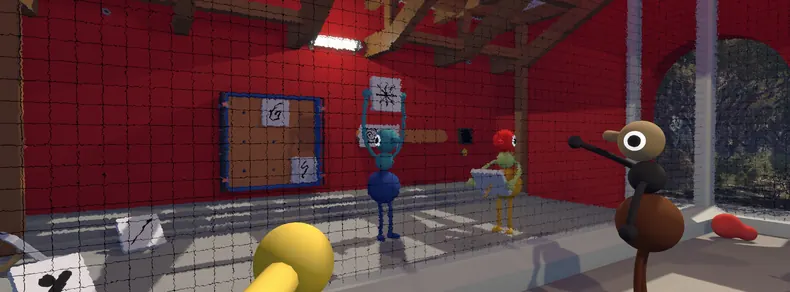
- The talking is the game. Big Walk builds its puzzles around voice chat itself — challenges where you cannot see each other, soundproof glass, items that extend your voice. Reviewers consistently flag this as the rare co-op game where talking to your friends is the mechanic, not background chatter. The official design position is even that using outside voice apps spoils it.
- Low stress, high comedy. There is no combat, no fail states that punish, no timer breathing down your neck — the challenge curve lives in coordination and geography (and, endgame, in the seven purple challenges). The funny moments come from physics and miscommunication, which is exactly the Untitled Goose Game recipe translated to multiplayer.
- It respects your group's time. Sessions save automatically on the host, the world adapts to 2, 3 or 4+ players, and there is no grind standing between you and the next puzzle. The saves system gets specific praise from groups playing across many evenings.
- Accessibility as a feature. Challenge skipping, full control rebinding, motion-reduction overlays and full-featured text chat earned specific mention — the game actively tries to be playable by mixed groups of abilities.
The honest caveats
Every review consensus has an underside, and Big Walk's is about fit rather than quality:
- It is multiplayer-first, full stop. There is no single-player mode — solo you can wander a little, but the game is built for two to twelve people talking. If your friend group never uses voice chat, this is the wrong purchase.
- No matchmaking. You bring your own friends, or you find them in communities (our guide to that).
- Pace is deliberately gentle. Players expecting PEAK-style adrenaline — the closest 2025–26 co-op comparison point — should calibrate expectations: Big Walk is a stroll with puzzles, not a scramble up a mountain. If you want the frantic version of co-op climbing, PEAK scratches that itch; Big Walk is the one you play to actually talk to each other.
Verdict
A 96% Steam rating across nearly forty thousand reviews is about as close to a consensus as games get: Big Walk is very good at exactly what it set out to be — a game about walking, talking and small-scale problem solving with your favourite people. Buy it for a group that chats; skip it for solo nights. If that describes your crew, the $19.99 asks very little (price details) and returns dozens of evenings — start tonight with the beginner guide.